AgentWatch
An open-source observatory for public reports of AI-agent incidents.
AI systems increasingly act on their own — running tools, taking actions, and operating with growing autonomy. When they behave in unexpected or unintended ways, people write about it: an agent that deleted the wrong files, ignored an instruction, took an action nobody approved, or behaved deceptively. Those reports are scattered across forums and social platforms, and the original posts often disappear.
AgentWatch exists to turn that scattered, disappearing evidence into a durable, searchable, and analysable record.
Project status
The end-to-end pipeline is built and runnable today: the data foundation, the
ingestion pipeline (pluggable collectors, evidence storage, normalisation,
scheduled collection), the classification + evaluation layer (pluggable
abstain-capable classifier, labelled eval set, regression gate), the web layer
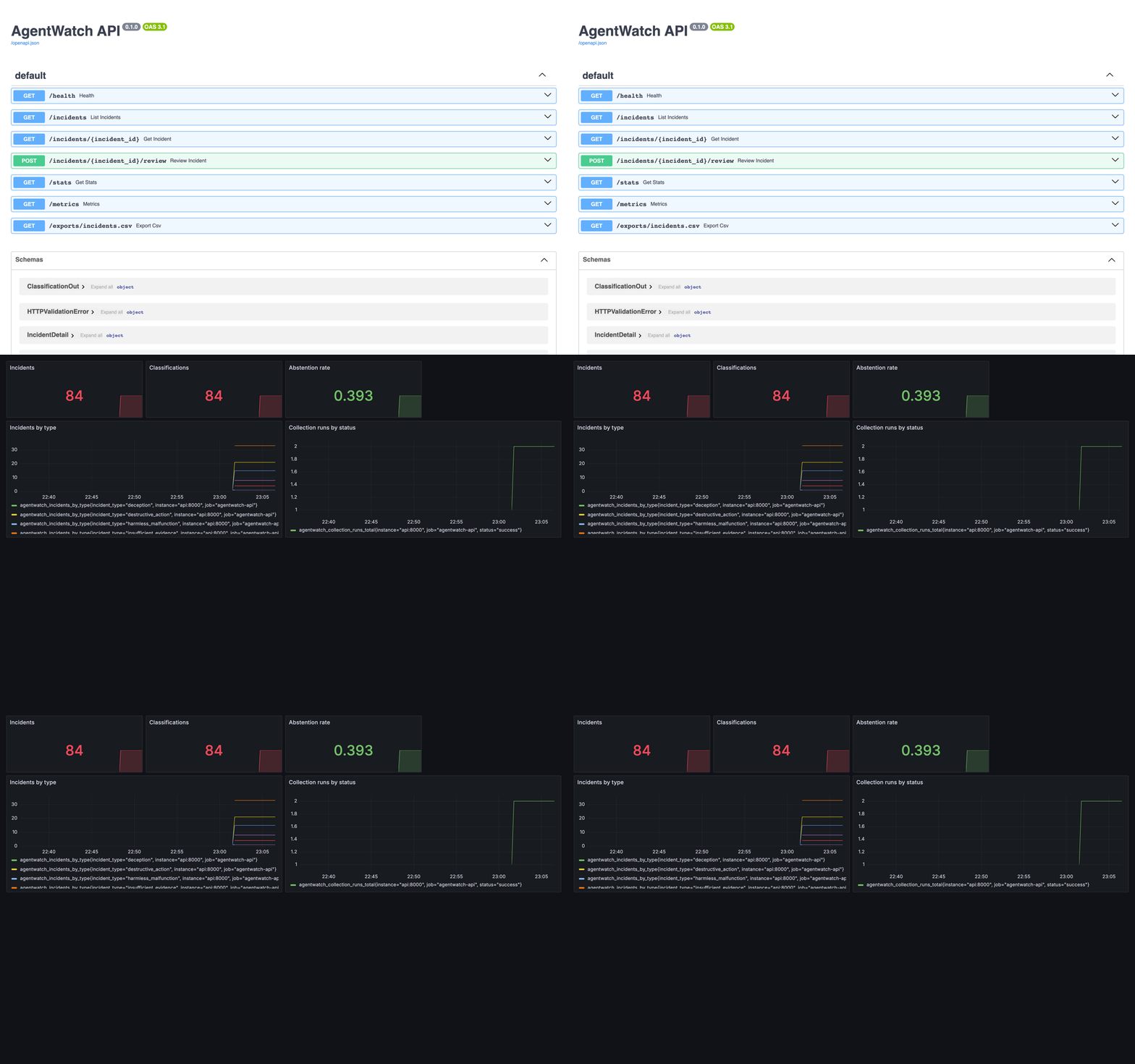
(documented authenticated HTTP API + React SPA review dashboard), and observability
+ deployment (Prometheus metrics, a provisioned Grafana dashboard, and a one-command
docker compose stack behind Caddy). Nothing here is aspirational.
Why separate raw evidence from interpretation?
The core design principle is that the original evidence and any interpretation of it are kept apart:
- A raw artifact is the source record, stored verbatim and hashed. It is never edited. If the original post is deleted, the evidence remains; if it is altered, the hash no longer matches.
- An incident is the cleaned-up, de-duplicated version used for analysis.
- A classification is a machine's opinion about an incident — always attributed to a specific model and prompt version, so it can be reproduced and audited.
- A review is a human's decision about a classification.
This separation means every conclusion can be traced back to the exact evidence it came from, and you always know whether a label came from a machine or a person.
Where to go next
- Architecture — the components that exist today and how they fit together.
- Collecting data — the sources, the pipeline, and how to run it.
- Classification & evaluation — the taxonomy, providers, and how quality is measured.
- API & dashboard — the HTTP API, authentication, and the review dashboard.
- Deployment & observability — one-command stack, metrics, and VPS/HTTPS.
- Data model — the full, table-by-table schema reference.
- Development — how to install, test, and extend the project.